Data Warehouses vs. Data Lakes: What Should Investment Firms Choose?
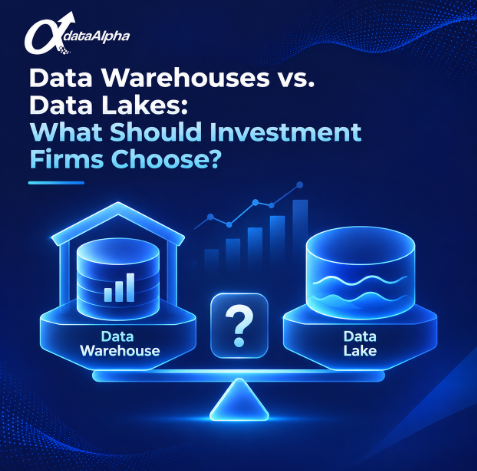
Investment firms manage large volumes of data daily, from market trends and portfolio performance to financial reports and client records. However, managing this information efficiently can be challenging without the right infrastructure.
Data warehouses and data lakes are two widely used solutions for financial data management. While both help firms store and analyze information, understanding their differences is important when choosing the right approach.
What Is a Data Warehouse?
A data warehouse brings together structured information from multiple sources into a centralized system. It allows investment teams to access organized, consistent data for reporting and analysis.
For investment firms, data warehouses support portfolio monitoring, financial reporting, and regulatory compliance. They also improve financial data quality management by maintaining consistency across different systems.
What Is a Data Lake?
A data lake stores large volumes of structured and unstructured data in its original format. This includes market feeds, financial documents, research reports, and alternative datasets.
Data lakes offer greater flexibility for investment firms using quantitative analytics solutions and predictive analytics tools. They enable teams to analyze complex datasets, identify market patterns, and support data-driven investment strategies.
Data Warehouses vs. Data Lakes: Key Differences
Although both technologies support financial data analytics, their applications differ.
- Data Warehouses: Suitable for structured data, financial reporting, portfolio analysis, and regulatory requirements.
- Data Lakes: Designed for handling diverse datasets, advanced analytics, machine learning, and investment research.
Which Solution Should Investment Firms Choose?
The right choice depends on a firm's operational needs and long-term data strategy.
A data warehouse is ideal for firms prioritizing consistent reporting, data accuracy, and regulatory compliance. A data lake is better suited for organizations working with large datasets and advanced analytical models.
For firms requiring both capabilities, a hybrid approach supported by a modern financial data management platform can provide greater flexibility and scalability.
Conclusion
Choosing between a data warehouse and a data lake requires a clear understanding of business objectives and data requirements. With the right data infrastructure, investment firms can improve operational efficiency, strengthen data governance, and make more informed investment decisions.